

The Battery Problem: Low Demand Parenting for a Crashing System
This is the last of a 4-blog series titled “Rebooting the System,” aimed at helping us navigate chaos created by others without losing our cool. This week? Low demand parenting and its place in your world. And we have yet another tool for you to download for free at the end of this 5-minute read!
Close the Background Tabs. All of Them.
I’m currently three cups of cold coffee deep and staring at a tower of hospital parking tickets—my personal monuments to parental chaos. And today, we’re finishing our system reboot by tackling the biggest energy drain of all.
Every single computer—from the shiny new Macbook to the ancient desktop humming in your basement—has a limit. It’s called RAM (Random Access Memory). If you’ve ever had 50 tabs open in Chrome while trying to stream a video, you know what happens: your laptop starts sounding like a jet engine and then freezes.
Guess what, friend? Your kid is the laptop.
And they have way too many tabs open.

The Hidden Energy Drain
For a child navigating chronic illness, medical complexity, or any kind of persistent pain/anxiety, just staying alive takes up most of their energy.
We need to think of these survival tasks as “background apps” running 24/7 that you, the caregiver, can’t ever truly close.
Imagine your child’s 100% daily battery life is being silently drained by:
- 20% Pain / Discomfort: The constant hum of “My stomach hurts” or “My head is fuzzy.”
- 30% Medication Side Effects: The meds keeping them stable also make them feel weird, dizzy, or nauseous.
- 40% Trauma Scanning: Constantly on alert, scanning the room for the next needle poke, strange doctor, or new treatment.
That is 90% of their battery gone before they even get to the Cheerios.
They now have 10% left. Ten percent!
So, when you ask them to manage a simple, “Please use your fork” or “Sit still during story time,” that demand might cost 15% of their remaining energy.
The result is inevitable: System Crash. (A full-blown, fire-alarm-level meltdown).
Low Demand Parenting: It’s Not Lazy, It’s Strategic Engineering
I used to be a parenting guilt magnet. I worried I wasn’t being strict enough. I worried that dropping a demand meant I was lowering my standards forever.
But as a “Systems Expert” (which is just a fancy title for a mom who lives by spreadsheets and caffeine), I looked at the data: You cannot run high-performance software on a battery that is at 1%.
You don’t need to be a doctor to see the system is red-lining. You need to be an engineer.
This is why we have to practice Low Demand Parenting.
This concept is rooted in the Cognitive Load Theory (the nerd stuff) and often discussed using The Spoon Theory framework (the tired mom stuff). It’s about auditing the total weight of demands you put on your child’s fragile system.
The Low Demand Audit: What to Keep, What to Drop
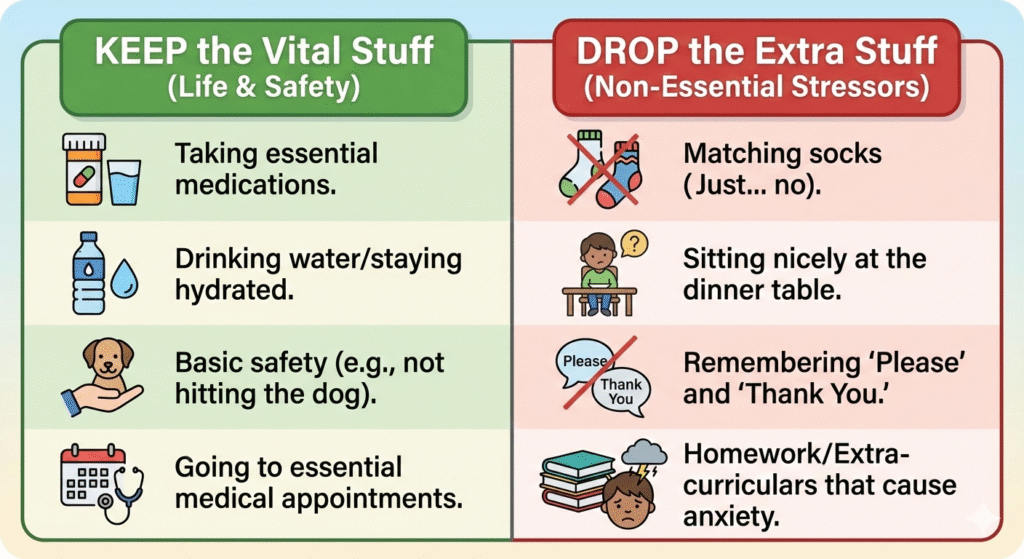
The Golden Rule: Drop the Rope
Stop fighting battles that don’t matter. The system is crashing. This is not the time to debate the proper way to hold a spoon. When you Drop the Rope, you stop expending your limited energy, too. You aren’t giving up; you’re just strategically conserving power.
Stabilizing the System
When we consciously close the extra tabs, the laptop stops overheating. When we lower the non-essential demands, our kids finally have enough energy left over to do the simple, beautiful things: to smile again, to cuddle, or maybe just to make it through one more difficult day without a total breakdown.
We aren’t lowering our standards forever. We are just waiting for the battery to fully recharge. We are creating a stable, safe platform from which they can heal, grow, and eventually, flourish.
Close the tabs. Drop the rope. Save the kid (and your sanity).
Free Download: The System Load Calculator
A simple worksheet to help you audit the non-essential demands and decide what to “Drop” to save your system (and your sanity).
Disclaimer: I am a Learning & Development Expert and a mother of a medically complex child. I am not a doctor. I am just a tired mom with a spreadsheet. This blog series is for educational purposes only (and some co-regulation). Please talk to your medical team about actual medical stuff.
Sources:
- Cognitive Load Theory by John Sweller
- Low Demand Parenting by Amanda Diekman
- The Spoon Theory by Christine Miserandino
Turn Hope Into Action: Support O’s Journey
Facing a second transplant is a battle no one should fight alone.
We have partnered with COTA to secure funds for O’s lifetime of care, turning our daily anxiety into a brighter future. This week, we are asking you to trade your latte for a life-change.
Please consider donating your “daily coffee spend”—whether it’s $5 or a week’s worth of brewing—to O’s COTA campaign. Small amounts add up to a massive impact.
Start by selecting the button below to make your coffee count.