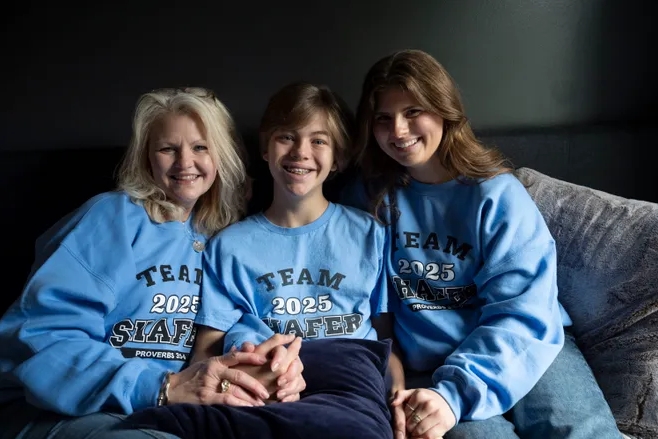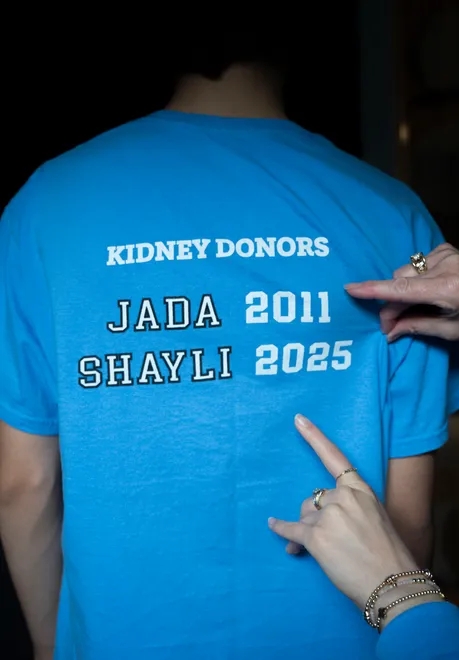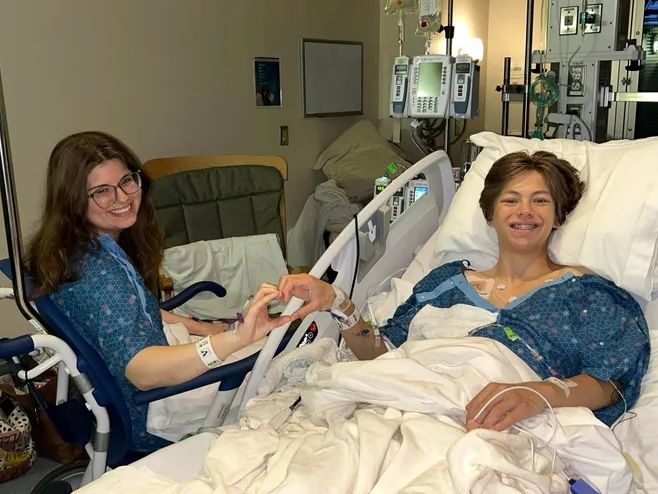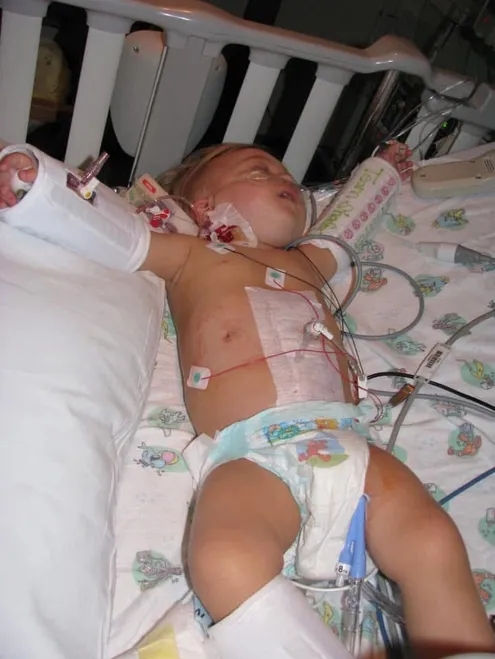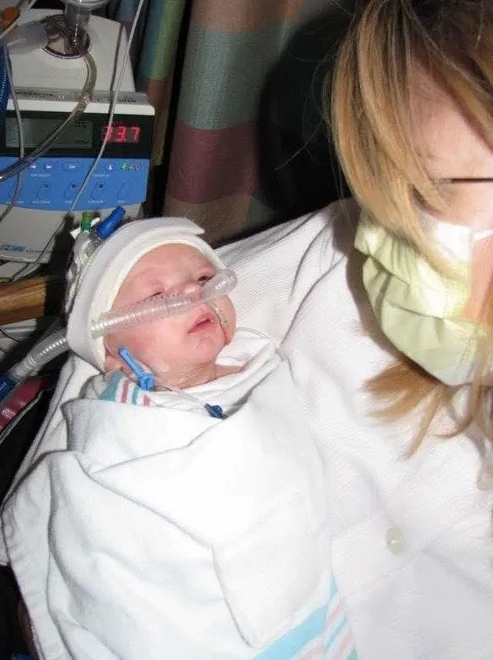


Facing an incredibly abnormal condition that destroys his kidneys, a teen’s mom and his sister each donated one of theirs — 14 years apart — so he could live.
Brad Schmitt – Nashville Tennessean
Key Points
- Shafer Daves, 15, of the Chattanooga area, was born with Denys-Drash syndrome, of which there are fewer than 300 cases documented worldwide.
- The condition almost always causes kidney failure and kidney cancer, and often leads to death.
- Chattanooga doctors wanted to move the newborn into hospice care to die when he was only 10 days old.
- A mother’s frantic calls to anyone and everyone she knew affiliated with Vanderbilt University Medical Center paid off.
- His first transplanted kidney started to fail after 10 years, so Shafer Daves’ oldest sister stepped up this year to donate her kidney, something she’d dreamed of and planned for since she was 9.
Only 10 days after an emergency C-section, doctors told the mom her baby wouldn’t make it through the night.
The baby survived.
Doctors diagnosed a rare condition, Denys-Drash syndrome, documented in only 300 people so far. It is a genetic disorder which destroys kidneys and usually kills babies before they reach 3 years old.
Now, Shafer Daves is 15.
Doctors said the baby needed to get to at least 20 pounds to even be considered for a kidney transplant.
The baby, Shafer Daves — the last of five children of a Chattanooga motivational speaker and her software engineer husband — reached that mark at 20 months in 2011.
Doctors said it might be hard to find a living donor; there needs to be a match of at least four of six antigens between donor and recipient.
Shafer Daves’ mother was a perfect match of 6 out of 6.
Doctors said 10-15% of transplanted kidneys are rejected in the first year.
Shafer Daves’ transplanted kidney lasted 14 years.
And when it was time for the teenager to get a new kidney this year, turns out his older sister, 23-year-old graduate student Shayli Daves, was a perfect match, too.
And a perfectly willing match: Shayli Daves said she has been hoping, dreaming and praying she’d be the donor for her baby brother ever since she was a 9-year-old girl watching him go through his first transplant when he was a toddler.
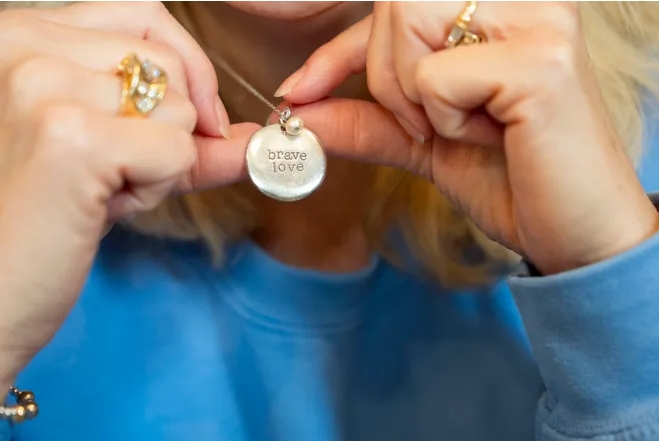
“We’ve had a ton of miracles right in a row,” said Jada Daves, the matriarch, kidney donater, breast cancer survivor and motivational speaker who now shares about her family’s struggles and successes in hopes of inspiring others who are walking through tough challenges.
“Even through all the years of Shafer’s serious medical issues, my life-threatening battle with triple negative breast cancer, and all the things in between,” she said, “I give thanks to God daily for this incredible life He has blessed me to live.”
‘I Lost It’
Jada and Kevin Daves first met at a singles group at the church they attended when they were students at University of Tennessee at Chattanooga.
“His confidence and sense of humor. He was so hilarious and sure of himself, I thought, this is the kind of guy I want to marry,” she said.
They married in 1994 but waited nearly a decade before having the first of their five children as he launched a career as a systems analyst and she became a teacher-turned-author-turned-motivational speaker who first got pregnant when she started a doctorate program at Vanderbilt University.
The couple had Shayli, now 23, attending physicians assistant school at Trevecca Nazarene University in Nashville; Sharayah, now 21, a singer-songwriter; Shanel, now a 19-year-old UTC student; and Shaw, now 17, who just graduated high school and got accepted to the University of the Cumberlands in Kentucky.
The couple home-schooled all of their children for most of their education. “If you haven’t sat at the kitchen table crying over math with your dad,” Shayli Daves said, smiling, “what have you done with your life?”
When Jada Daves got pregnant with her last child, she kept telling her doctor something was wrong. But all the tests and the ultrasounds indicated it was a perfect pregnancy. None of that convinced Daves.
“It was heartbreaking; I felt like my medical team wasn’t listening,” she said. “I knew in my soul something was wrong with that baby.”
The problems started early on in delivery at Parkridge East in Chattanooga, then Eastridge Hospital, when the medical team suddenly stopped getting any vital signs for the baby.
“We’ve gotta get the baby out now!” a doctor said loudly as hospital staffers raced her toward the operating room.
“God, please save my baby!!” Jada Daves screamed.
The baby, Shafer, appeared normal at first, and a nurse chirped, “Happy baby!” as she handed the newborn to Jada Daves. Later that day, though, doctors said they thought there might be some genetic issues.
The baby boy had problems breathing and feeding, and needed surgery to repair a congenital diaphragmatic hernia, where part of the bowel pierces through the diaphragm. In surgery, doctors discovered the baby had enlarged kidneys and needed to perform a biopsy.
By 10 days old, doctors said Shafer might not survive until the next morning.
For a brief time, Jada Daves felt desperately hopeless.
“I lost it,” she said. “I thought we’d gotten through the hard part with terrible delivery. And then I thought, why me? I was exasperated.”
Soon after, physicians told Jada and Kevin Daves they were sending the baby to hospice care. The doctors at T.C. Thompson Children’s Hospital at Erlanger said no other hospital would accept a transfer.
She and her husband turned back to their faith. And something clicked in Jada Daves.
“We’re going to have a funeral in three days? No!” she remembers saying. “We need to fight!”
The Vanderbilt graduate school alum decided to use every contact and connection she had to try to find someone at Monroe Carell Jr. Children’s Hospital at Vanderbilt to try to save her youngest.
Within days, the baby was in an ambulance, headed to Nashville.
“Now the Lord is giving me hope,” she said, “and from then on, I felt like we were going to make it.”
‘I know Jesus, I’ll be fine’
Doctors there stabilized the baby and said the next step would be a kidney transplant, when the baby reached 20 pounds, which would be tough since Shafer ate very little.
But Jada and Kevin Daves persisted in getting the baby’s weight up at home, and Jada Daves was a perfect 6-for-6 match to donate her kidney.
As her mom was getting tested, Shayli, then 9, the oldest of the Daves kids, said she wanted to be the kidney donor.
Shayli earnestly told her mom and dad that her mother shouldn’t risk her life because she has five children to raise. And Shayli explained that since she’s strong in her faith, she’ll go to heaven if she dies.
“I know Jesus, I’ll be fine!” Shayli insisted, sparking an emotional reaction from her parents.
“Kevin and I are bawling our eyes out,” Jada Daves said.
Her mother patiently explained that donors needed to be at least 18 years old, and that her brother might need another kidney down the road, so Shayli should be ready.
Shayli swore to herself — and to her teachers, preachers and anyone else who’d listen — that she would be her brother’s next organ donor.
“I knew that [transplanted] kidney would fail one day,” Shayli Daves said, “and I was just waiting until I hit 18, because I just knew I’d be my brother’s donor one day.”
The morning of that first kidney transplant, in 2011, Jada Daves said she was dancing and singing with joy.
“I didn’t have an ounce of fear,” she said.
She had reason to be joyful; the transplant was a success, and Shafer went home with few restrictions, though he fought through frequent urinary tract infections and other illnesses for the first two years.
Through all of that, Shafer lived a “fairly normal” life between frequent surgeries, growing in his family’s faith, playing rec league basketball and developing a love for peacocks, instilled in him by his Papaw on Papaw’s farm in Benton, Tennessee.
There, Shafer looks after 11 peacocks, mesmerized by the beauty of their feathers.
Still, medical issues started to pile up after his transplanted kidney started to fail in 2023. No one was surprised when Shayli scored a 6-for-6 match as a potential donor. A family friend also tested, but Shayli Daves emerged as the donor.
“My whole life, I said I was gonna be the donor,” Shayli Daves said, shrugging and smiling.
She and her brother went into Vanderbilt University Medical Center last month with no fear.
“I feel like my family is always there with me, that I never have to do it alone,” Shafer said. “I had a lot of peace through this whole transplant. A peace from the Lord has been over me and over Shayli.”
The family has remained in Nashville in a rented apartment as brother and sister heal, and a grateful mother takes care of them.
Jada Daves’ husband has been back in Chattanooga with the rest of their children, confident through his faith that things would go well in Nashville.
“I truly felt they were all covered in prayer,” Kevin Daves said, “and that made me confident in the plan.”
Jada Daves said she can’t help but be grateful despite the medical challenges because of how well everything has turned out so far.
“It feels like we are such a perfectly blessed family,” she said.
“Here’s a child born with an extremely rare and almost always fatal disease. He finds two biological matches, perfect matches, from one family,” she said. “And we are all spiritually, emotionally and physically fulfilled.”
Jada Daves is particularly grateful her oldest daughter last month got to fulfill what Shayli Daves believed to be her destiny in being her baby brother’s organ donor.
“He doesn’t just have her kidney,” Jada Daves said, “he has her whole heart.”
Do you know an inspirational story about people in Middle Tennessee? Reach Brad Schmitt at brad@tennessean.com.
To become a kidney donor
About 90,000 people are waiting for kidney donations, which is the vast majority of the 103,000 people on the national transplant waiting list, according to figures from the federal Health Resources and Services Administration.
Kidneys can be harvested within 36 hours from people who’ve died.
Most people also can live with one of their two kidneys, making many adults eligible to become living donors, like Jada and Shayli Daves did in this story.